

Second Quarter 2026: Stocks Crush Fear
Brushing off concerns about the long-term, global economic and geo-strategic impacts of the U.S. war with Iran, investors looked to the bright side in the second quarter and drove global stock prices much higher. Key positives included continued robust AI investment, strong and broadening corporate earnings growth, a mostly stable interest rate environment, and a surprisingly benign economic backdrop.
The start of the year saw investor anxiety rise alongside oil prices. The closure of the Strait of Hormuz - an event long-feared by thoughtful observers for its potential to severely disrupt the global economy, led to a quick doubling of spot oil prices. Brent Crude peaked (for this period) at $138 on April 7, 2026. Worries about higher inflation weighed on expectations. These factors combined to create a very negative environment for the stock market in the first quarter, resulting in negative returns for the major U.S. and international stock indices.
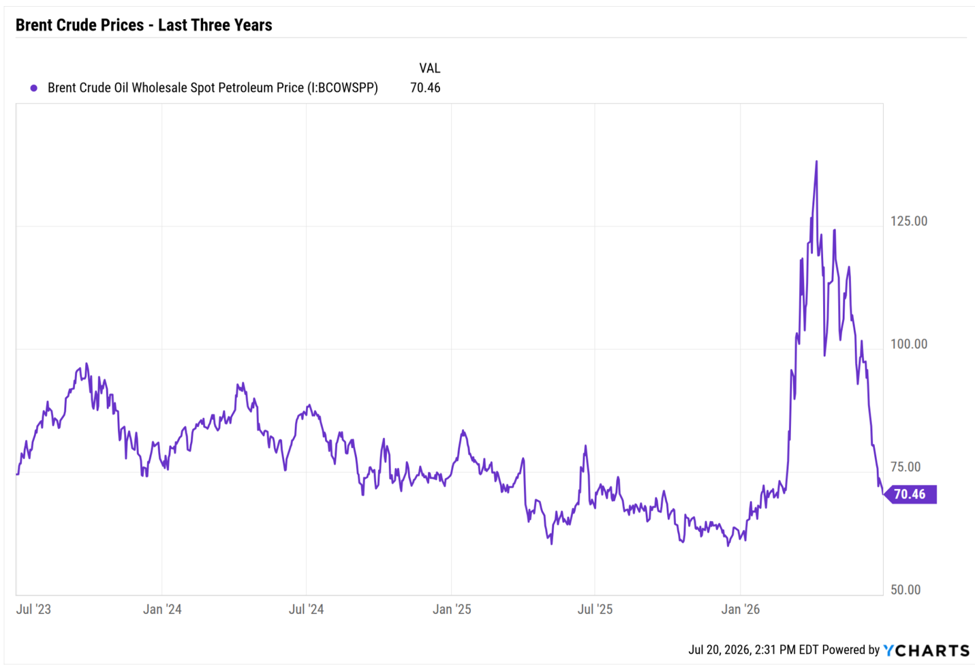
As it turned out, at least in the near term, that soup of bad news also created the environment for an unusually strong second quarter for global stock markets. Although oil prices didn't return to their pre-war levels, they came a long way back toward them. This was partly due to an off-and-on (and off) easing of tensions between the U.S. and Iran. Only time will tell, but global investors seemed to assign a diminished role to that particular geopolitical concern as the world discovered the extent of oil reserves and perhaps a more diversified and robust energy landscape.
Asset Class Performance (as of June 30, 2026)
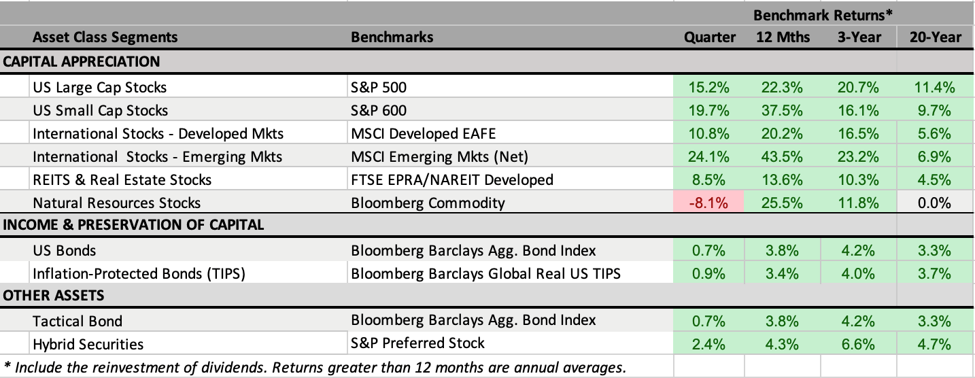
The S&P 500, an index of the largest U.S. companies, increased 15.2% in the quarter, more than recovering from its 4.3% drop in the first quarter.
Somewhat unusually compared to the recent past, however, U.S. large cap stocks were not the best performing category. Smaller company stocks performed even better, up nearly 20% during the quarter and strongly outperforming the S&P 500 over the last 12 months. While over long historical periods, smaller company stocks did outperform larger company stocks, it has been more than a decade and a half since this has been the case on a sustained basis.
Emerging market stocks delivered the highest returns in the quarter, continuing a strong recent run.
The lone laggard category was natural resource-related stocks, no surprise given the sharp drop in oil prices that fueled rises elsewhere.
Bonds and Interest Rates
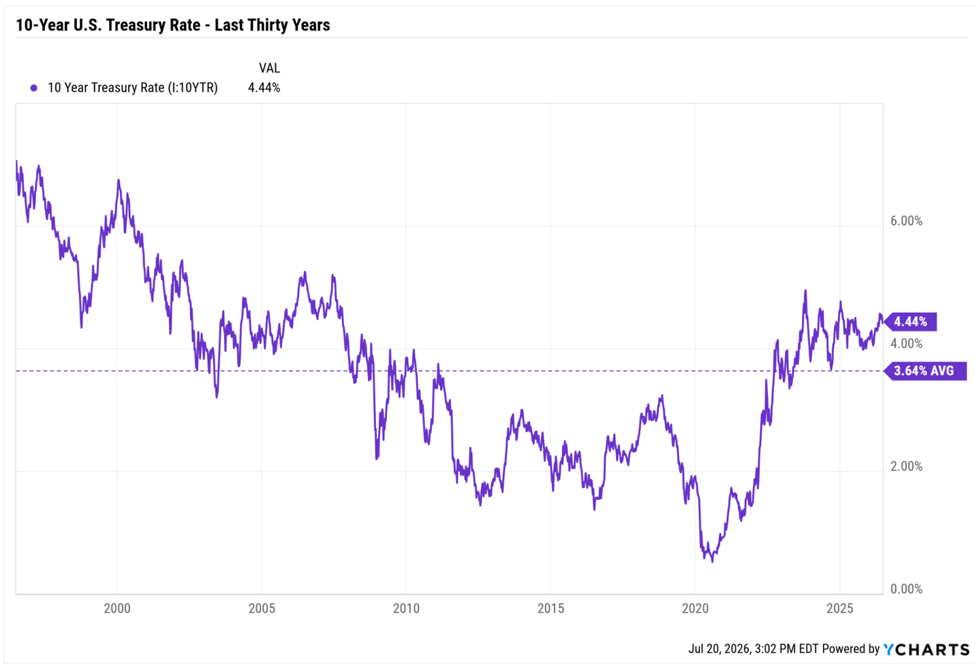
Intermediate-term interest rates have mostly fluctuated in a narrow range over the last four years. The 10-Year U.S. Treasury rate, illustrated below, first re-crossed the 4.0% threshold in October 2022. Since then, it has mainly stayed within the 4.0-4.5% range and now sits at the high end of that range.
Interest rates have risen more so far this year at the shorter end of the yield curve than farther out, a sign perhaps that while near-term inflation concerns have increased, long-term inflation expectations haven't changed as much.
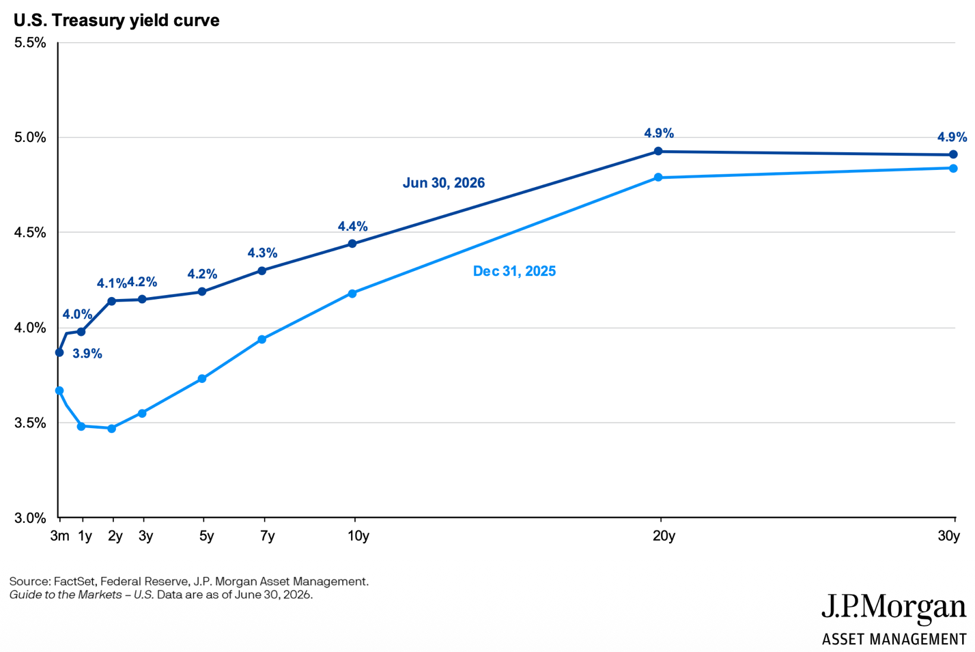
There is no better predictor of intermediate-term bond returns than current interest rates. When U.S. Treasuries offer 4.5% coupons and solid investment-grade corporate bonds offer 5.5% coupons, that range makes a good baseline expectation for intermediate-term bond returns. In the second quarter, the Barclays’ Aggregate Bond Index returned just below that annualized level due to the slight rise in rates during the quarter.
A historically slim spread between average-grade corporate bonds and U.S. Treasuries suggests that investors are not presently too concerned with credit or economic risk.
With substantially more political and legal friction than should have been the case, there was in the end a relatively normal changeover of Federal Reserve chairmen during the quarter. Inflation, economic and geopolitical news meant that Kevin Warsh's first meeting as chair gave no indication of a pending cut in rates. Investors will be watching closely to assess whether the tradition of Federal Reserve independence is steadfastly maintained.
The Difficulty of the New
One truly remarkable market development during the quarter was the initial public offering of Space Exploration Technologies (aka SpaceX). We've highlighted the exceptional business and stock performance of a handful of companies over these last many years, and the Magnificent 7 did more than enough to earn their moniker. This SpaceX initial listing deserves a spot very high up on the list of most stunning market events of all time.
Time has passed, the economy has changed, inflation has occurred and all that . . . but no amount of lens adjusting can diminish the spectacular nature of this SpaceX offering. SpaceX offered about 556 million shares for sale at $135 apiece, creating a total offering of $75 billion (the value of the shares sold) and a total company market value of about $1.8 trillion.
A few tidbits offer some perspective on just how unusual it was:
- Tesla (Elon Musk's other company) went public sixteen years earlier (2010), sold $225 million worth of shares, and had a $1.7 billion valuation (i.e., 1 / 1,000th) the size of SpaceX;
- Amazon went public in 1997 at a valuation of less than $0.5 billion;
- Meta (Facebook) probably comes the closest among U.S.-based startups going public. It sold $16 billion worth of stock in its 2012 initial offering at a valuation just over $100 billion, still just 1 / 15th the size of SpaceX;
- The SpaceX offering on its own was similar in size to all of the roughly 250 public offerings from the four prior years combined.
At the risk of further boring you and as fans of financial statements and the information they convey, we present here for the record SpaceX's income statement from its IPO registration. Go figure . . .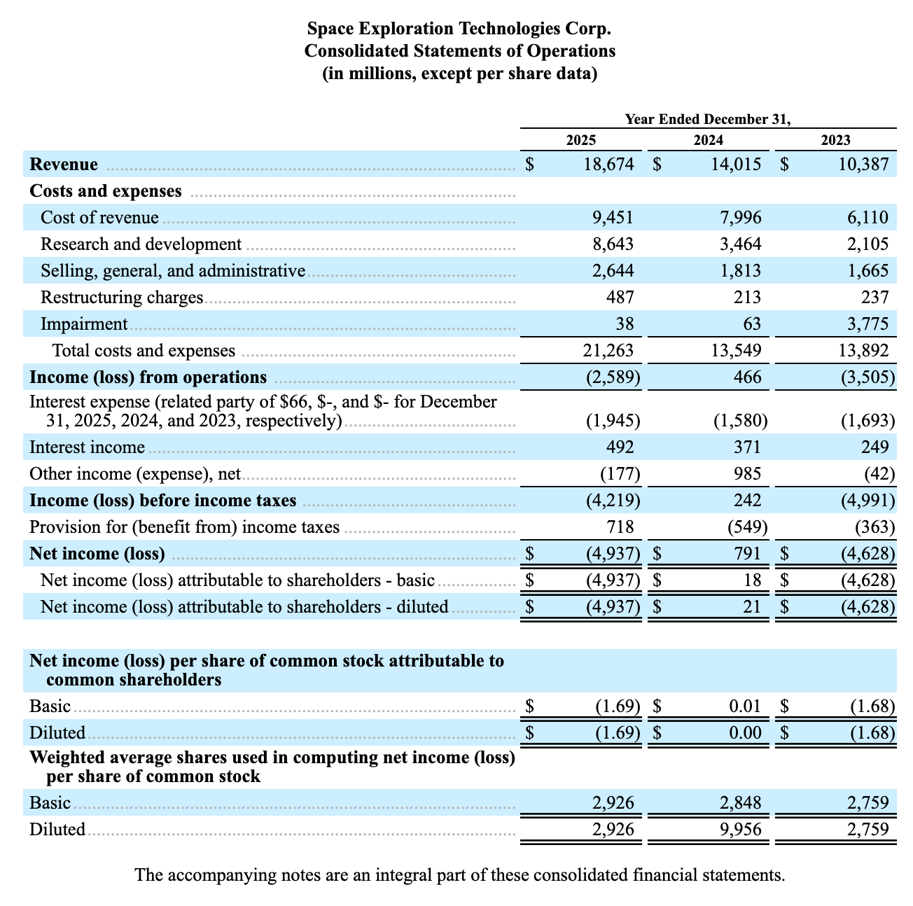
We understand that SpaceX is valued not on its past or present, but on its future, and we readily concede we have great difficulty deciding the investment merits of new companies in nascent industries projecting rapid growth. SpaceX decidedly falls into our 'too hard' pile, so we offer no opinion, just awe, at the size public markets have afforded this wonder.
A Great World Cup
Forty-five countries, plus hosts U.S., Canada, and Mexico, just pulled off a wonderful edition of the quadrennial global soccer competition. As Americans, we loved that so many foreign visitors came to the U.S. and - no surprise - how warmly they were welcomed across the continent. As soccer fans, we found it wonderful to watch the skill and determination of teams and teammates. We promise (fingers crossed behind our backs) we didn't watch any games during market hours.
We won't stretch to make an investment analogy, and we are making no such claim that the World Cup's feel-good factor had any impact on global stock market performance. We only offer this simple reflection on the joy that sport can bring and wonder at its ability to inspire global connections.
As ever, feel free to reach out with questions or updates.
One of Bristlecone Value Partners’ principles is to communicate frequently, openly, and honestly. We believe that our clients benefit from understanding our investment philosophy and the process behind it. Our views and opinions regarding investment prospects are "forward-looking statements" and may not be accurate over the long term. While we believe we have a reasonable basis for our appraisals and confidence in our opinions, actual results may differ materially from our expectations. Information provided in this blog should not be considered as a recommendation to purchase or sell any particular security. You can identify forward-looking statements by words like "believe," "expect," "anticipate," or similar expressions when discussing particular portfolio holdings. We cannot assure future results and achievements. You should not place undue reliance on forward-looking statements, which speak only as of the date of the blog entry. We disclaim any obligation to update or alter any forward-looking statements, whether as a result of new information, future events, or otherwise. Our comments are intended to reflect trading activity in a mature, unrestricted portfolio and might not be representative of actual activity in all portfolios. Portfolio holdings are subject to change without notice. Current and future performance may be lower or higher than the performance quoted in this blog. References to indexes and benchmarks are hypothetical illustrations of aggregate returns and do not reflect the performance of any actual investment. Investors cannot invest directly in an index, and returns do not account for the deduction of advisory fees or other trading expenses. There can be no assurance that current investments will be profitable. Actual realized returns will depend on, among other factors, the value of assets and market conditions at the time of disposition, any related transaction costs, and the timing of the purchase. Economic factors, market conditions, and investment strategies will affect the performance of any portfolio, and there can be no assurance that a portfolio will match or outperform any particular index or benchmark. Past Performance is not indicative of future results. All investment strategies carry the potential for profit or loss. Changes in investment strategies, contributions, or withdrawals can materially alter a portfolio's performance and results. Different types of investments involve varying degrees of risk, and there can be no assurance that any specific investment will be suitable or profitable for a client's investment portfolio. This content is developed from sources believed to provide accurate information, and it may not be used to avoid any federal tax penalties. Please consult legal or tax professionals for specific information regarding your individual situation. The opinions expressed and material provided are for general information and should not be considered a solicitation for the purchase or sale of any security.